
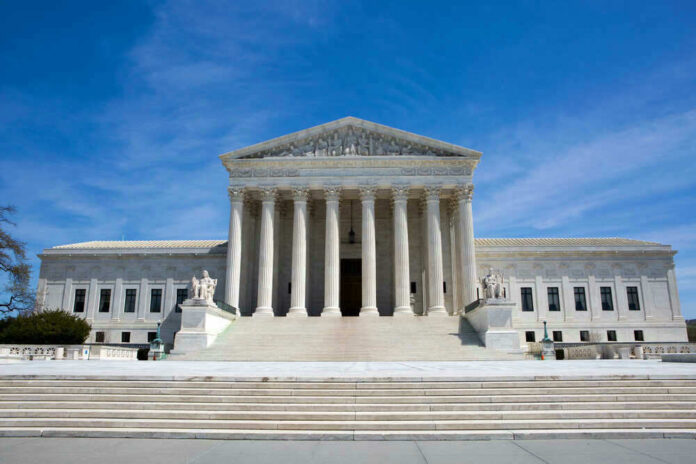
The Supreme Court delivered a stunning setback to President Trump’s immigration enforcement efforts, blocking his attempt to deploy National Guard troops to Chicago and undermining executive authority to protect American communities from illegal immigration chaos.
Story Highlights
- Supreme Court rejects Trump’s bid to send National Guard to Chicago for immigration enforcement
- Court cites Posse Comitatus Act, finding insufficient authority for military deployment
- Three conservative justices dissented, signaling split on presidential powers
- Ruling blocks troops despite Trump’s successful deployments in D.C., Los Angeles, and Portland
Court Blocks Immigration Enforcement Deployment
The Supreme Court rejected President Trump’s emergency request to override a lower court injunction preventing National Guard deployment to Chicago.
The December 23rd ruling represents a significant obstacle to Trump’s immigration crackdown, despite the administration’s argument that troops were necessary to support federal law enforcement operations.
The unsigned order temporarily prevents military assistance in addressing Illinois’s immigration challenges, leaving federal agents without crucial backup in sanctuary jurisdictions.
Supreme Court won’t allow National Guard deployment to Chicago in major loss for Trumphttps://t.co/65uZnnZopl
— The Hill (@thehill) December 24, 2025
Legal Authority Questions Divide Justices
The Court’s majority found the Trump administration failed to demonstrate proper legal authority under the Posse Comitatus Act for military involvement in civilian law enforcement.
However, three conservative justices—Samuel Alito, Clarence Thomas, and Neil Gorsuch—filed dissenting opinions, suggesting they would have supported Trump’s constitutional authority as commander-in-chief.
Justice Brett Kavanaugh’s concurring opinion indicates potential middle ground, though the specific reasoning remains unclear in this preliminary ruling.
Broader Immigration Strategy Continues Despite Setback
While the Chicago deployment faces legal hurdles, Trump has successfully deployed National Guard troops to Washington D.C., Los Angeles, and Portland over local Democrat opposition.
These deployments demonstrate the administration’s commitment to enforcing immigration laws despite resistance from sanctuary jurisdictions.
White House spokesperson Abigail Jackson emphasized that Tuesday’s ruling doesn’t derail the core mission of protecting federal personnel and property from violent interference with lawful immigration enforcement operations.
The administration’s multi-city approach reflects Trump’s determination to fulfill campaign promises about immigration enforcement, even as Democrat governors like Illinois’s J.B. Pritzker celebrate legal obstacles.
Pritzker’s characterization of lawful executive authority as “authoritarianism” exemplifies the resistance Trump faces from officials who prioritize protecting illegal immigrants over supporting federal law enforcement efforts in their communities.