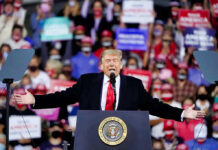


BREAKING UPDATE:
BREAKING: Trump announces halt to any plans for strikes on Iranian power plants pic.twitter.com/n156UaLevr
— The Spectator Index (@spectatorindex) March 23, 2026
President Trump’s 48-hour ultimatum over the Strait of Hormuz signals that America is done pretending energy blackmail is “diplomacy.”
Quick Take
- Trump warned Iran he will strike and “obliterate” Iranian power plants if Tehran does not fully reopen the Strait of Hormuz to commercial shipping within 48 hours.
- The Strait of Hormuz is a narrow chokepoint that carries roughly 20% of global oil and liquefied petroleum gas, making any disruption an immediate kitchen-table issue due to higher prices.
- Reports describe commercial oil and gas traffic as effectively paralyzed, with no clear sign yet that escorted tanker flows are restoring normal transit.
- The ultimatum lands amid a widening U.S.-Israel-Iran conflict featuring missile exchanges and strikes on energy infrastructure, raising the risk of escalation.
Trump’s 48-hour Hormuz ultimatum and the power-plant threat
President Donald Trump posted on Truth Social on Saturday evening, March 21, 2026, warning Iran that the U.S. will “hit and obliterate” Iranian power plants—starting with the largest—if Tehran does not fully reopen the Strait of Hormuz to commercial ship traffic within 48 hours.
The deadline lands around Monday, March 23. Multiple outlets reported the same key details, framing the message as a sharp escalation tied directly to restoring maritime commerce.
Energy markets do not need much imagination to understand why this matters. The Strait of Hormuz is a narrow, roughly 21-mile-wide passage between Iran and Oman that carries about one-fifth of global oil and liquefied petroleum gas.
When commercial traffic stalls there, price spikes can move from trading screens to the gas pump fast. That is the practical backdrop for Trump’s ultimatum: the U.S. is treating the strait as an economic lifeline, not a bargaining chip.
How the conflict widened from military targets to energy chokepoints
Reports describe the current blockade and shipping paralysis as tied to a U.S.-Israeli war on Iran that has entered its fourth week. In the days leading up to Trump’s post, the conflict expanded into strikes on major energy assets, including Israel’s reported strike on Iran’s South Pars gas field and subsequent retaliation involving regional facilities.
By the weekend, reporting also cited missile strikes affecting Israel and a U.S.-U.K. base at Diego Garcia, underscoring how quickly the theater can widen.
🚨 “If Iran doesn’t FULLY OPEN, WITHOUT THREAT, the Strait of Hormuz, within 48 HOURS from this exact point in time, the United States of America will hit and obliterate their various POWER PLANTS, STARTING WITH THE BIGGEST ONE FIRST…” – President DONALD J. TRUMP pic.twitter.com/htLz1A0Mf7
— The White House (@WhiteHouse) March 22, 2026
Iran’s posture has been described as selectively restrictive—pressuring adversaries while signaling some openness for neutral nations. Japanese media reporting cited Tehran talking with Tokyo about passage for vessels, and other coverage referenced Iranian discussion of transit fees on ships.
Those signals matter because they indicate Iran may aim to monetize control rather than impose a permanent closure. Still, for the U.S. and its allies, any “permission-based” global trade route is a direct challenge to freedom of navigation.
Economic stakes: when foreign crises hit American households
The immediate economic risk is straightforward: fewer ships moving through Hormuz can mean less supply reaching global buyers, which can drive higher oil and gas prices. Coverage cited Brent crude trading around $112.19 on Friday amid the disruption.
For American families, that kind of volatility collides with fresh memories of the inflationary years—when overspending and weak energy policy made everyday life more expensive. The political reality is also clear: energy shocks become domestic issues quickly, regardless of where they start.
Reporting also indicated the U.S. Treasury allowed the sale of already-loaded Iranian oil despite sanctions, an attempt to ease price spikes. That detail illustrates the bind policymakers face when global supply tightens: sanction pressure competes with consumer pain.
Trump’s approach, as reflected in this ultimatum, prioritizes reopening the route rather than leaning mainly on market workarounds. The available reporting does not confirm what compliance mechanisms, verification steps, or deconfliction channels would accompany any follow-through.
Allies, deterrence, and the limits of “escorts” without action
Another theme in the reporting is allied hesitation. Some accounts describe offers of escorts or reinsurance support while also noting frustration inside the coalition and harsh rhetoric aimed at NATO for its reluctance.
Whatever one thinks of the tone, the strategic question is real: commercial shipping depends on credible security guarantees, not statements. If insurers and shippers believe risk remains uncontrolled, traffic can stay sidelined even when naval assets are present, keeping pressure on energy prices and supply chains.
For now, the key limitation is timing: as of March 22 reporting, the 48-hour clock was still running, and post-deadline outcomes were not yet available. What is clear is that Trump has attached a public, time-bound demand to a specific consequence aimed at Iranian infrastructure.
Supporters will view that as reasserting deterrence and protecting commerce; critics will warn about escalation. The only fact-based conclusion at this stage is that the next steps depend on whether shipping resumes and whether either side chooses to widen the target set.
Sources:
https://fortune.com/2026/03/21/trump-iran-war-48-hours-deadline-strait-of-hormuz-power-plants/
https://www.jpost.com/international/article-890725