
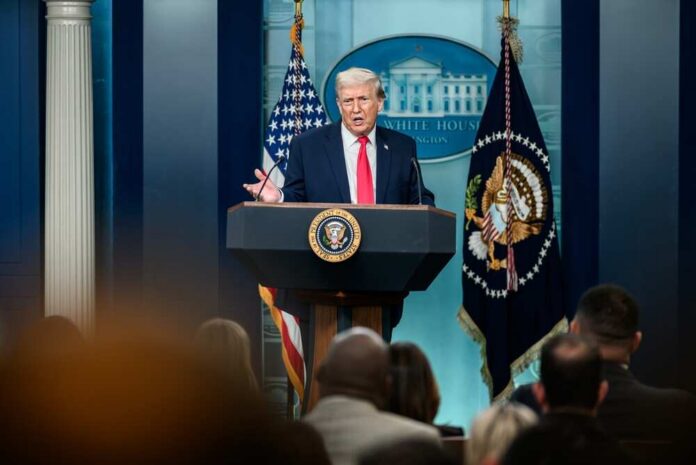
BREAKING UPDATE: TRUMP HAS CANCELED TODAY’S CAMP DAVID MEETING AND WILL HOLD IT AT THE WHITE HOUSE.
A rare Camp David Cabinet meeting, tied to active Iran negotiations, signals a moment when quiet talks could harden into real terms—or unravel on contact with politics and missiles.
Story Snapshot
- White House plans a rare Cabinet session at Camp David as Iran talks reach a pivotal point [1][4]
- Media framing links the venue and timing to the endgame of a broader peace track [1][2][4]
- Camp David’s prestige can amplify perceptions without guaranteeing outcomes [3]
- Prior high-level huddles show venue-as-signal dynamics in national security decision cycles [5]
Why Camp David Now Matters More Than Usual
President Donald Trump’s team scheduled a rare Cabinet meeting at Camp David as reports describe Iran negotiations entering a critical phase, fusing symbolism with urgency in a way Washington understands intuitively but seldom confirms on paper [1][4].
The timing follows months of episodic progress and setbacks, with accounts that the United States and Iran have edged closer to a broader peace construct in late May [2]. The move invites two readings: decisive strategy session or calculated theater to pressure counterparts—and both can be true in diplomacy’s late innings.
President Trump is expected to take the unusual step of holding a Cabinet meeting at Camp David on Wednesday, The Washington Times has confirmed. https://t.co/CDCGgU4fnr
— The Washington Times (@WashTimes) May 26, 2026
Camp David heightens stakes because it functions as a presidential war room without the optics of the West Wing. Reporters latch onto its rarity to gauge momentum, a habit born of necessity when official readouts run thin.
The White House’s own description underlines that the retreat is a stage for consequential diplomacy, not routine scheduling, which strengthens the “this is serious” interpretation while stopping short of proving a breakthrough [3]. Symbolism is a tool in negotiations; it can rally allies, warn adversaries, and set expectations ahead of final text.
Signals, Noise, and the Discipline of Facts
Coverage tying the meeting to a “critical phase” offers a coherent narrative, but the public record still lacks a line-by-line agenda, decision memo, or formal readout that would confirm a policy pivot or finalized ceasefire terms [1][4]. Claims of nearness to a broader deal rely on timeline snippets and on-background framing rather than treaty language [2].
Prior strategy sessions have gathered top officials for hours to hash targets, red lines, and off-ramps without yielding immediate public decisions, reminding observers not to confuse choreography with outcome [5]. Prudence demands patience until communiqués catch up to choreography.
Common sense suggests administrations do not burn a Camp David card for a nothingburger. But sober analysis recognizes that high-stakes settings often serve leverage more than closure. If Iran’s negotiators weigh domestic hardliner pushback, a conspicuous American huddle can apply pressure by implying readiness to escalate or to finalize terms. That dual-use purpose fits values of peace through strength: signal unity, demonstrate capacity, and keep the door open if terms protect U.S. interests and allies.
The Late-Game Playbook in High-Risk Diplomacy
Negotiations that approach the finish line typically compress decision windows, increase leader-level engagement, and test-market outcomes through controlled leaks. The Fox News and CBS News reports reflect that cadence: a “rare” convening, a “critical phase,” and the suggestion that talks are going “nicely,” all of which create both momentum and accountability for any stalling party [1][4].
The timeline captures the macro arc—months of conflict, then a potential opening—consistent with standard endgame sequencing in crisis diplomacy [2]. The venue punctuates the message; the communiqué reveals its substance—when it arrives.
Trump to convene rare Camp David Cabinet meeting amid rising Iran tensionshttps://t.co/30R04msxcO
— ABC 33/40 News (@abc3340) May 26, 2026
Policy durability will hinge on verifiable constraints, enforcement snapbacks, and the alignment of regional deterrence with ceasefire mechanisms. Many will judge success by whether the deal reduces threats to American personnel, supports Israel’s security, punishes violations, and avoids ransom optics.
Camp David’s gravitas can frame that bar but cannot lower it. Until officials publish parameters, treat the meeting as a strong signal, not a signed contract. Watch for post-session indicators: synchronized allied statements, calibrated military posture shifts, and specific compliance pathways tied to timelines.
Sources:
[1] Web – Trump calls rare Camp David Cabinet meeting amid critical Iran talks
[2] Web – 2025–2026 Iran–United States negotiations – Wikipedia
[3] Web – Camp David – The White House
[4] Web – Trump to hold Cabinet meeting at Camp David on Wednesday
[5] Web – Trump discussed Gaza, Iran goals at Camp David strategy session