
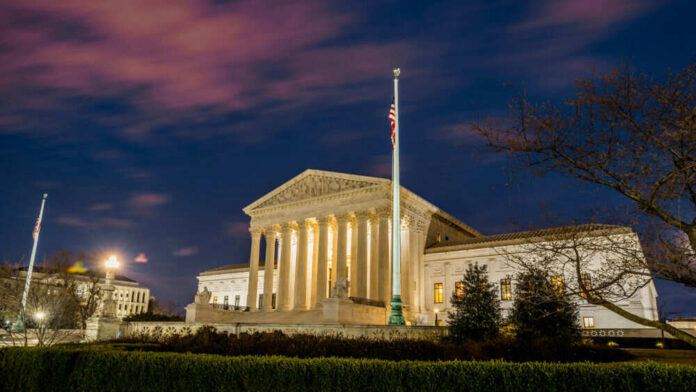
The Supreme Court shut the door—twice—on President Trump’s bid to erase the $5 million E. Jean Carroll verdict, leaving the jury’s judgment fully in place.
Story Snapshot
- A New York jury found Trump liable for sexual abuse and defamation and awarded $5 million.
- The Supreme Court declined review, leaving the verdict intact, with no noted dissents.
- A second request for reconsideration also failed at the Supreme Court.
- The United States Court of Appeals for the Second Circuit had already affirmed the judgment.
What the High Court’s Silence Actually Means
The Supreme Court denied review of Trump’s appeal on June 29, 2026, without explanation and without any Justice publicly dissenting, which left the verdict intact and enforceable. The Court then rejected a follow-up bid to reconsider that denial.
That second “no” confirmed the end of this appeal path. Denial of review is not a ruling on the merits. It simply means the lower court’s decision stands and the case is over at the Supreme Court.
Supreme Court again rebuffs Trump in $5M E. Jean Carroll case https://t.co/8oKlAF3wut pic.twitter.com/hge04FPI1f
— New York Post (@nypost) August 17, 2026
Trump called the case a “Fake Case” after the denial. His public stance remains a full denial of Carroll’s claims. But the judiciary’s path is settled for this verdict: trial judgment, appellate affirmance, and then certiorari denied—twice.
The message for any litigant, famous or not, is plain. Once a jury’s fact findings are affirmed on appeal, the Supreme Court rarely steps in unless a clear legal conflict or major national question exists.
How the Case Reached a Final Stop
A Manhattan jury in 2023 found Trump liable for sexual abuse and for defamation tied to his 2022 public statement, and awarded Carroll $5 million.
The United States Court of Appeals for the Second Circuit reviewed challenges to the evidence and upheld the judgment, including the district court’s evidentiary rulings and the damages award. That affirmance set the stage for a steep climb at the Supreme Court, where only a small fraction of civil cases get heard each term.
Trump’s team argued the trial judge allowed evidence that hurt him unfairly. The Supreme Court’s refusal to take the case left the Second Circuit’s view in place that the evidentiary rulings did not warrant a new trial.
Many may ask whether lower courts were even-handed in admitting prior-acts evidence. The appellate court said yes, under the rules that allow such proof in sexual-misconduct cases. With that settled on appeal, the Supreme Court saw no need to intervene.
What the Verdict Did—and Did Not—Decide
The jury found sexual abuse, not rape, a legal distinction that shaped the damages and headlines. The panel also found that Trump defamed Carroll with a specific 2022 statement, which the jury viewed as false and damaging to her reputation.
Trump has repeatedly denied the accusations and attacked the case as fabricated, both in sworn testimony and public posts. Civil liability standards differ from criminal proof. The jury weighed credibility and ruled on the preponderance of the evidence.
BREAKING: The U.S. Supreme Court has REJECTED Trump’s renewed request to hear his appeal of the $5 MILLION verdict in favor of E. Jean Carroll.
The nation’s highest court has once again refused to intervene.
Trump loses again. pic.twitter.com/mehd5WzNzK
— Darline Graham Q🇺🇸 (@DarlinGrahamSC) August 18, 2026
Many people now blur this $5 million verdict with a separate $83.3 million defamation judgment about different statements. They are distinct tracks with different legal issues and timelines.
The Supreme Court’s action here concerned the $5 million case. The justices passed on that record, twice. That choice ends this chapter. It does not speak to every other dispute, nor does it bless every step below. It signals only that nothing met the Court’s high bar for review.
Sources:
apnews.com, abcnews.com, theguardian.com, cnbc.com, scotusblog.com, en.wikipedia.org, reuters.com