

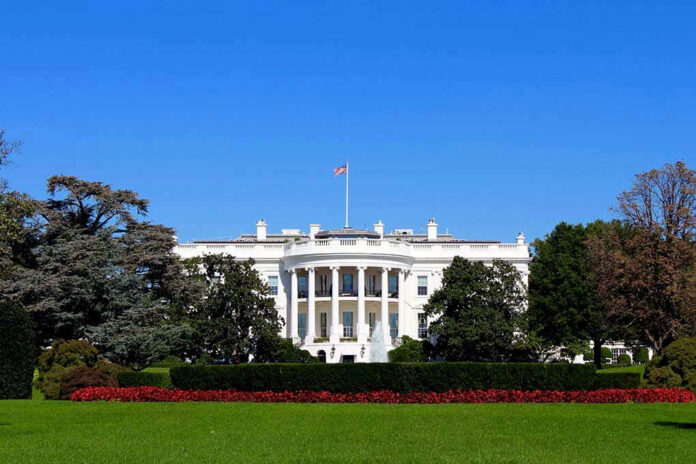
President Trump demolishes part of the historic White House East Wing to build a massive private ballroom, marking the most radical alteration to America’s most sacred residence in over a century.
Story Snapshot
- Demolition of White House East Wing facade begins for Trump’s $250 million ballroom project.
- Entirely privately funded by Trump and major corporations, including Apple, Amazon, and Lockheed Martin.
- The 999-seat ballroom will be the most extensive White House expansion since the early 1900s.
- Construction continues unaffected during the federal government shutdown due to private financing.
Trump’s Bold Vision Becomes Reality
Bulldozers rolled onto White House grounds in October 2025, tearing down the East Wing facade to make way for President Trump’s ambitious ballroom project.
The $250 million construction represents the largest White House expansion since the early 20th century, fulfilling Trump’s campaign promise to modernize America’s premier presidential residence. Clark Construction leads the massive undertaking, with completion targeted before Trump’s term ends in 2029.
🚨 JUST IN: Construction workers at President Trump's direction have BEGUN demolition on the East Wing facade to build the DJT-funded ballroom
Trump has PROMISED it will match up perfectly with the current White House architecture. No "modernist" BS.
Amazing things are… pic.twitter.com/dwSqd6MLGr
— Eric Daugherty (@EricLDaugh) October 20, 2025
Private Funding Shields Project From Government Gridlock
Trump’s strategic use of private funding ensures that the ballroom construction proceeds without congressional interference or budget constraints.
Major corporations, including Apple, Amazon, Lockheed Martin, and Coinbase, contribute alongside Trump’s personal investment, demonstrating strong business confidence in his administration.
This private funding model allows construction to continue even during the current federal government shutdown, unlike typical government projects dependent on taxpayer dollars.
Historic Precedent Set for Presidential Legacy Projects
The East Wing demolition breaks new ground in White House history, surpassing previous renovations by Truman and Kennedy that preserved existing structures.
Built in 1902 and expanded in 1942, the East Wing served administrative functions for over a century before Trump’s bold reimagining. The National Capital Planning Commission requires approval only for new construction, not demolition phases, streamlining the unprecedented project timeline.
999-Seat Ballroom Enhances Presidential Hosting Capacity
The new ballroom will accommodate 999 guests, dramatically expanding the White House’s event-hosting capabilities for state dinners and diplomatic functions.
Trump claims every previous president wanted such a facility, positioning the project as fulfilling a long-standing presidential need rather than personal luxury.
White House Chief of Staff Susie Wiles emphasizes the administration’s commitment to preserving White House history while modernizing its functionality for 21st-century diplomacy.
Critics questioning the project’s necessity ignore the practical benefits of enhanced diplomatic hosting capacity and modernized security integration.
The Secret Service oversees comprehensive security modifications throughout construction, ensuring the expanded facility meets contemporary protection standards.
This forward-thinking approach demonstrates Trump’s commitment to strengthening America’s diplomatic infrastructure while respecting the White House’s historical significance through careful preservation efforts in unaffected areas.
Sources:
White House State Ballroom – Wikipedia
The White House Announces White House Ballroom Construction to Begin