

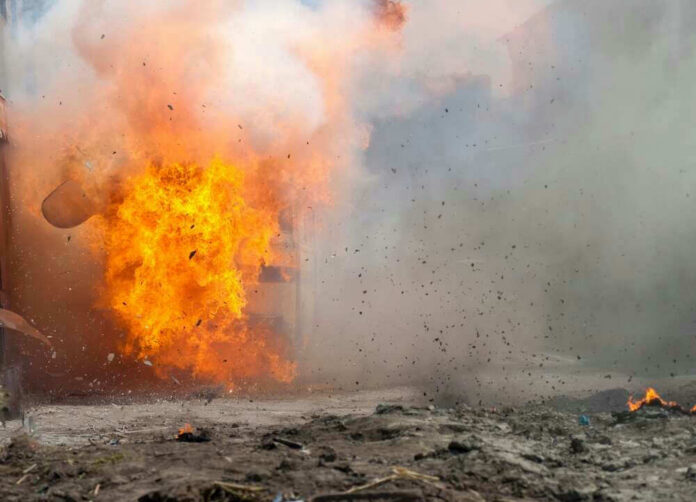
The most advanced missile in Russia’s arsenal just tore through Ukraine’s capital region at hypersonic speed, and almost everything we “know” about it rests on claims no outsider can yet prove.
Story Snapshot
- Russia unleashed one of its largest mixed missile-and-drone barrages of the war against Kyiv and surrounding areas, killing and injuring civilians.[1][3]
- Ukrainian leaders and Western media say Moscow used the nuclear-capable Oreshnik hypersonic missile, described as nearly impossible to intercept.[1][2][4]
- Russia frames the strike as retaliation for Ukrainian attacks in occupied Luhansk and on “civilian facilities” inside Russia.[1][3][6]
- Despite dramatic footage, there is still no publicly released forensic evidence linking this specific strike to Oreshnik rather than to another advanced system.[1][3][4][6]
A massive overnight strike that pushed the war into new territory
Russia did not simply lob one exotic missile at Kyiv; it executed an hours-long strike package that looked like a stress test of Ukraine’s entire air-defense network.[1][3]
Reports from the ground describe roughly 90 missiles and about 600 drones launched against the capital and its surrounding region, one of the heaviest barrages in four years of war.[1][3][4]
Shopping centers, apartment blocks, government buildings, a water facility, and dozens of other sites took hits when interceptors were overwhelmed, and leakers got through.[1][2]
Russia uses hypersonic Oreshnik missile in mass attack on Kyiv https://t.co/1uODtIX6Pt
— The Washington Times (@WashTimes) May 24, 2026
Ukrainian officials say they intercepted most of the incoming weapons, but not all.[1][3][4] When you launch close to 700 aerial weapons in one night, “most” still leaves a lot of steel falling on a city.
Russia’s Ministry of Defense then publicly framed the entire operation as retaliation for earlier Ukrainian strikes, including a deadly hit on a student dormitory in occupied Luhansk and alleged attacks on civilian facilities inside Russia.[1][3][6]
Kyiv denies deliberately targeting civilians, insisting its strikes hit military assets.
The Oreshnik narrative: a hypersonic message, not just a missile
Within that chaos, one weapon became the headline: the hypersonic Oreshnik, variously reported as Oreshnik, Archnik, Arashnik, and even simply as a 9M723 hypersonic missile.[1][2][3][4]
Ukrainian authorities and multiple outlets say Russia used this missile as part of the Kyiv-region strike, only the third time it has appeared in the war after earlier attacks near Dnipro and Lviv.[1][3][4]
President Volodymyr Zelenskyy reportedly warned publicly that intelligence had detected launch preparations and that such a missile was coming, yet Ukraine still could not stop it.[4]
Broadly described, Oreshnik is an intermediate-range, nuclear-capable ballistic system that flies at roughly ten to eleven times the speed of sound and can carry several hundred kilograms of explosives.[1][3][4]
Commentators in Western media call it “unstoppable” or nearly impossible to intercept, stressing its ability to maneuver at hypersonic speed and potentially carry multiple warheads or submunitions.[1][2][4]
Some analyses even allege Russia may have used inert, non-explosive warheads in earlier Oreshnik strikes, relying purely on kinetic energy at impact to achieve destructive effect.[4] From a strategic viewpoint, the point is not just damage; it is terror, signaling, and nuclear overtones.
Why missile nomenclature and evidence gaps matter more than headlines
There is a problem serious readers should not gloss over: the public record around this specific weapon is messy, and most of it is secondhand.[1][2][3][4]
Reports use several names—Oreshnik, Archnik, Arashnik—and, in one case, fold them into the 9M723 label, which is associated with the Iskander family.[3][4]
That may reflect transliteration quirks, tight deadlines, or genuine confusion in the early hours after the strike. Either way, sloppy naming is a red flag when dealing with high-end systems everybody wants to hype.
More importantly, what we do not have in public is as important as what we do. None of the cited coverage includes debris photos matched to known Oreshnik components, serial numbers, or a technical field report that an independent analyst could verify.[1][3][4] There are no released radar tracks showing an unmistakable flight profile from a known launch site to a geolocated impact point.
Russia’s own side is selectively forthcoming: some reports say Moscow confirmed using its “powerful” hypersonic missile in the overnight barrage, but without a primary-source transcript or detailed strike package.[1][2][6]
Escalation, deterrence, and propaganda on both sides
Strip away the glamour of the word “hypersonic,” and the picture looks more familiar: a nuclear power uses advanced weaponry to punish an adversary, signal resolve, and test Western red lines.[1][3][4]
European leaders quickly condemned Russia’s decision to employ this missile against Ukraine, arguing it marked another escalation and a reminder of Moscow’s nuclear-capable arsenal.[2][5]
Russian officials counter that the strike was justified payback for Ukrainian attacks inside Russia and in occupied territories.[1][3][6] Neither side is a neutral referee; both are fighting for global opinion as much as for terrain.
BREAKING:
Russia Confirms Use of Oreshnik Hypersonic Missiles in Ukraine AttackBila Tserkva, Ukraine — In a striking display of military technology, Russia has officially confirmed the deployment of Oreshnik hypersonic missiles in an attack on a Ukrainian military airfield… pic.twitter.com/EuYXXgNfWu
— the FlyingDutchmen🇳🇱🇵🇭🇷🇺🇭🇺🇷🇺 🇨🇳 (@GerritdeH) May 25, 2026
The takeaway is straightforward. First, the attack itself is not in serious dispute: hundreds of drones and missiles were launched, civilians died, and Kyiv’s defenses were strained.[1][2][3]
Second, Russia is clearly willing to reach for some of its most sophisticated hardware to send political messages, whether or not those weapons are truly “unstoppable.”[1][4]
Third, the specific Oreshnik label remains underverified in public, because the kind of forensic proof that would settle the argument—open debris analysis, shared radar plots, declassified intelligence—remains locked behind wartime secrecy on both sides.[1][3][4][6]
In other words, the missile was real, the strike was deadly, but the story you are hearing is still shaped less by lab-grade evidence than by propaganda and perception management.
Sources:
[1] YouTube – At least 4 dead after Russia fires hypersonic Oreshnik …
[2] YouTube – Russia’s deploys Oreshnik hypersonic missiles on deadly …
[3] YouTube – Russia hits Kyiv with hypersonic missile in massive assault
[4] YouTube – Russia condemned for using Oreshnik hypersonic missile …
[5] Web – Russia uses hypersonic Oreshnik missile in mass attack on …
[6] Web – Russia uses hypersonic Oreshnik missile in mass attack on …