
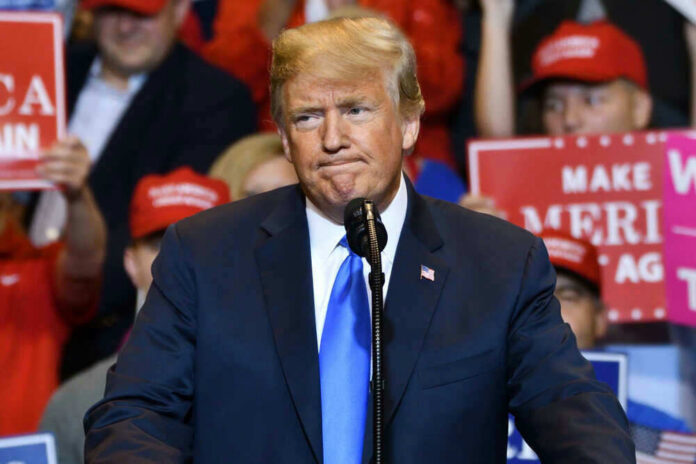
President Trump promised $5,000 to every American adult if Republicans keep control of both chambers of Congress, and then he doubled down on it.
Story Snapshot
- Trump tied a $5,000 “Trump dividend” to Republican wins in the House and Senate.
- Multiple outlets reported the same pledge during the Dallas convention.
- He repeated the promise days later and defended its affordability.
- Reporters pegged the cost at over $1 trillion with no funding plan given.
Trump’s Dallas pledge set a clear condition and a big dollar figure
President Trump told a packed Republican midterm convention in Dallas that every American adult would get $5,000 if Republicans hold the House of Representatives and the United States Senate.
He branded it the “Trump dividend” and framed it as a direct cash payment to adults, not a tax credit or voucher. Coverage from major outlets captured the same line and the same condition within the same news cycle, anchoring what he said as a matter of record.
The wording left little wiggle room. The trigger was specific: both chambers, not one. Reports also noted Trump added an America-first spending twist, saying the money should be used in the United States.
He joked about not wanting people to cross the border to spend it, which underscored the idea that the payment should boost domestic demand, not leak abroad through travel or imports at the point of sale.
President Trump doubled down on his promise to send $5,000 to every American adult if Republicans retain control of the House and Senate in November, insisting the country can "easily" afford the massive proposal.
"We have trillions of dollars coming into the country, and the… pic.twitter.com/4mKcfAThY9
— FOX Business (@FoxBusiness) September 14, 2026
Repetition turned a headline into a position
Trump repeated and defended the pledge in the days after Dallas. He told reporters he did not float the idea only to juice turnout and argued the economy could handle it. That second round matters.
A one-off line can be a flourish. A repeat becomes a stake in the ground. The Associated Press and other outlets documented the follow-through, which locked the promise into the campaign’s policy file.
The size of the promise drove the next wave of coverage. Reporters placed the likely price tag above $1 trillion. Some used adult population counts that push the total closer to $1.35 trillion.
Those numbers put the pledge in the same weight class as major rescue packages, not routine tax tweaks. Outlets also stressed that Trump named no funding source when he announced the plan.
The mechanics run through Congress and the Treasury
Any nationwide cash payment needs a legal pipeline. Congress would have to pass a law to authorize and fund checks at this scale. The Treasury Department would then need direction, data, and systems to send payments and verify eligibility.
Trump did not release bill text, a budget score, or an executive path that could bypass Congress. That leaves the legislative branch as the gatekeeper for timing and design.
Labeling the payment a “dividend” is political framing, not a legal category by itself. Real dividends come from profits to shareholders. Federal cash programs come from taxes, borrowing, or asset sales approved by law.
The name signaled a share in national growth, but the pipeline would still be the budget process with all its steps, tradeoffs, and caps. That is why many observers looked immediately to cost and debt.
The politics, costs, and common-sense filters
Cost drives the first common-sense question: who pays and when. Reuters placed the estimate near $1.35 trillion, while others said “over $1 trillion.” The number depends on which adult count and payment rules apply.
Reporters also set those figures against the large federal deficit. That comparison is not nitpicking. It frames whether Congress could swallow new borrowing or would need cuts or new revenue to offset the checks.
Critics called the pledge a bribe. Supporters called it a growth bet. The news coverage did not settle the legal debate but did capture the charge and the defense. The sound path blends respect for voters with math that adds up.
Paying adults directly is simple and popular. Doing it without a pay-for is where support falters. If the White House supplies a funding plan tied to spending restraint, energy revenue, or targeted savings, the case grows stronger.
Sources:
apnews.com, usatoday.com, reuters.com, theguardian.com, bbc.com