
President Trump has struck a decisive blow against Democrat-controlled states attempting to strangle American AI innovation with their regulatory overreach, signing an executive order that establishes federal supremacy over artificial intelligence governance.
Story Overview
- Trump signs executive order creating single national AI regulation framework, blocking state-level control
- Democrat strongholds California and New York lose power to impose burdensome regulations on tech companies
- AI Litigation Task Force established to challenge existing state AI laws through legal action
- States refusing compliance face potential loss of $42.5 billion in broadband funding
Federal Authority Asserts Control Over State Overreach
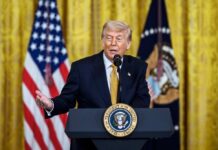
President Donald Trump signed the executive order on Thursday, December 11, 2025, declaring that excessive state regulation threatens America’s competitive edge in artificial intelligence.
The order specifically targets Democrat-led states like California and New York, which have been attempting to impose their progressive regulatory frameworks on the rapidly growing AI industry.
AI and crypto czar David Sacks, alongside tech investor Chamath Palihapitiya, Sen. Ted Cruz, and Commerce Secretary Howard Lutnick, witnessed the Oval Office signing ceremony.
President Donald J. Trump signs an Executive Order to protect American AI innovation from an inconsistent and costly compliance regime resulting from varying state laws.
"We have to be unified. China is unified…" pic.twitter.com/II9gz5yDx7
— Rapid Response 47 (@RapidResponse47) December 11, 2025
Tech Companies Celebrate Victory Against Regulatory Burden
Major technology companies including OpenAI, Google, and venture firm Andreessen Horowitz have lobbied extensively for this federal preemption approach. These companies argued that navigating fifty different state regulatory regimes would cripple American competitiveness in the global AI race.
The executive order language emphasizes that “United States AI companies must be free to innovate without cumbersome regulation,” directly addressing industry concerns about state-level interference.
AI companies have invested heavily in political influence, establishing offices near the Capitol and funding a super PAC with at least $100 million for the 2026 midterm elections.
Legal Enforcement Mechanism Targets Non-Compliant States
The executive order establishes an AI Litigation Task Force under the attorney general’s authority, specifically designed to challenge existing state AI laws through federal court action.
This represents a significant escalation in the federal government’s approach to state regulatory defiance.
The task force’s “sole responsibility” will be pursuing legal action against states that maintain their own AI regulatory frameworks, ensuring uniform national standards prevail over local political agendas.
Financial Consequences for State Resistance
States refusing to comply with the new federal AI framework face substantial financial penalties through restricted access to federal broadband funding. The Commerce Secretary must specify compliance conditions for the Broadband Equity Access and Deployment program within ninety days of the order’s signing.
This $42.5 billion program aims to expand high-speed internet access in rural areas, making the funding restriction a powerful enforcement tool. The approach demonstrates Trump’s commitment to using federal leverage against state resistance to his administration’s deregulatory agenda.
Constitutional Federalism Debate Intensifies
The executive order reignites fundamental questions about federal versus state authority in emerging technology regulation. While the original Republican spending bill included a proposed ten-year ban on state AI regulation, this provision was removed before Trump signed the legislation in July.
The current executive order approach allows the administration to pursue federal preemption without congressional approval.
This strategy aligns with conservative principles favoring uniform national standards over the patchwork of state regulations that often reflect progressive political priorities rather than economic competitiveness concerns.