
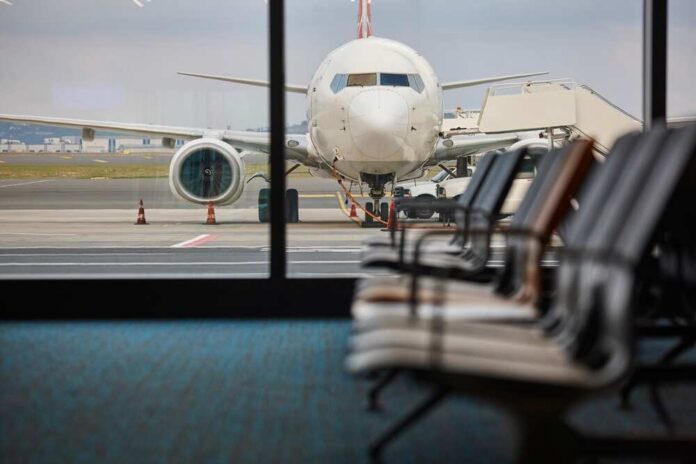
Dozens of bomb threats rattled European skies this week, yet every searched plane turned up clean.
Story Snapshot
- Authorities searched multiple planes across Europe and found no explosives.
- Anonymous emails and tips triggered diversions, fighter escorts, and airport sweeps.
- A Wizz Air jet diverted to Budapest, was checked, and then continued safely.
- Experts say most threats prove false, but each must be treated as real until cleared.
A Week Of Threats, A Stack Of Negative Searches
Officials in several countries said bomb squads and police teams combed aircraft after a rapid wave of threats, and none reported finding a device. The British Broadcasting Corporation reported eight targeted aircraft earlier in the week were cleared with no explosives discovered; LOT Polish Airlines also said no suspicious items were found. The Associated Press said Italian bomb-disposal experts found nothing on a Finnair flight that landed in Rome, and Czech police reported the same for four planes in Prague.
Wizz Air described a high-stress but methodical response. A London Luton to Sofia flight diverted to Budapest after a threat, passengers and the plane underwent checks, and the airline said the inspection finished with nothing found before the journey continued. That outcome matched the broader pattern reported across Europe, where anonymous messages sparked urgent action, then ended with negative results. Authorities still moved fast, because the cost of assuming wrong at 35,000 feet is not acceptable.
How Anonymous Tips Turn Into Full-Scale Operations
Police and border agencies said many alerts arrived by email or through anonymous tips, which can be sent in seconds and trigger hours of checks. Bulgarian border police reported an email claiming an improvised device on a flight into Sofia, and the transport minister said two aircraft were searched with no explosives found. This method imposes large, real-world costs with little risk to the sender. The public sees diversions and escorts and assumes danger; the search teams see a workload measured in gate delays and trace swabs.
Airlines, airports, and governments do not get to shrug. Standard operating procedures force them to treat each threat as real until crews and specialists close it out. Reuters reported that while the vast majority of bomb threats end as false alarms, all must be handled as real until investigation is complete. That is not bureaucracy; that is risk math. You verify first, then exhale. The result is a set of dramatic scenes that often resolve to “nothing found” and a long line of missed connections.
Are These Hoaxes Random, Or Something Organized?
Security analysts floated several hypotheses, including copycat callers, a single serial hoaxer, or state-linked hybrid campaigns. Matthew Borie of Osprey Flight Solutions said the concentration in Europe could suggest a Russian angle and noted Iranian hybrid activity as another possibility, while listing non-state patterns like one actor or a wave of imitators. CBS News highlighted that at least 25 flights were affected in a week and quoted an expert calling the scale a “deliberate act” rather than several random calls.
🚨 BREAKING: Wave of Bomb Threats Disrupts Flights Across Europe ✈️
At least 11 planes have been diverted or forced into emergency landings across Europe on Thursday after bomb threats. Flights from Dublin, Copenhagen, Helsinki, Madrid, Milan and Warsaw were among those…
— TheVoteDesk (@TheVoteDesk) November 5, 2026
These claims argue plausibility, not proof. The European Union transport commissioner’s uncertainty about links across incidents, and the lack of named perpetrators so far, keep the coordination question open. A conservative reading of the facts says this: no devices were found; threats arrived in similar ways; authorities acted to protect life; and attribution remains unsettled. That posture matches common sense. Keep passengers safe first, then show the receipts when investigations close.
What Matters Now: Speed, Deterrence, And Transparency
Air travel depends on three things in moments like this: speed to respond, deterrence to reduce repeats, and transparency to maintain trust. Speed looked solid this week. Fighter escorts, diversions, and bomb checks unfolded as designed. Deterrence needs work. Anonymous emails should not be a cheap way to snarl a continent. Law enforcement should push hard on message headers, routing data, and any voice remnants that can unmask the sender and lead to charges that stick.
Transparency is the third leg. People will accept disruption if officials show clear, consistent facts after the dust settles. The British Broadcasting Corporation and the Associated Press provided that backbone: nothing found on planes in Italy, the Czech Republic, Bulgaria, and on diverted flights like Wizz Air’s. Reuters framed the base rate cleanly: most threats are false, but every one must be checked. That is the honest deal with aviation security. It is not “cry wolf.” It is “verify, then fly.”
Sources:
bbc.com, bbc.co.uk, apnews.com, reuters.com, sanluisobispo.com