

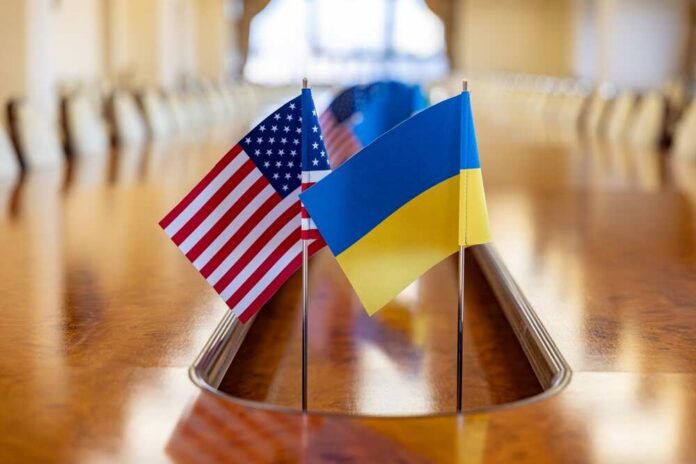
Russia just put a name and a date on the next round of Ukraine peace talks, and the first lady is now running her own parallel diplomatic track from the White House.
Quick Take
- Kremlin spokesman Dmitry Peskov confirmed Russia will join trilateral talks with Ukraine and the United States in Abu Dhabi on November 10 and 11.
- Vladimir Medinsky, an aide to Russian President Vladimir Putin, will lead Moscow’s delegation at the table.
- First Lady Melania Trump is separately set to host Russian and Ukrainian representatives at the White House, building on a six-day ceasefire she helped broker in Oleshky.
- Ukrainian officials say they expect only modest results, not a full breakthrough, from the first Abu Dhabi session.
Moscow Names Its Negotiator And Puts A Date On The Calendar
Peskov told reporters on November 3 that Russia would send Medinsky to Abu Dhabi for talks spanning security arrangements, de-escalation steps, humanitarian issues, an energy ceasefire, and a Black Sea truce tied to food exports. U.S. special envoy Steve Witkoff is reported to be helping broker the American side. That is a real negotiating channel with named officials, not a vague promise floated through anonymous sources.
Reporting also flagged something bigger simmering in the background: a possible three-way summit between President Trump, Putin, and Chinese President Xi Jinping. Nothing about that meeting is locked down yet. No date, no venue, no joint statement from any of the three governments. But the fact it is even on the table shows how far this diplomatic push has already traveled beyond a routine ceasefire discussion.
Melania Trump’s Oleshky Ceasefire Gives The Process A Track Record
The White House says Melania Trump personally initiated contact that secured a ceasefire covering Oleshky and surrounding Kherson region areas, allowing evacuations and humanitarian work to continue. That truce held for six days before ending on November 1, while fighting kept going elsewhere along the front. It is a small, localized result. It is also proof that narrow agreements can be reached even while the larger war grinds on.
Now she is set to host Russian and Ukrainian representatives directly at the White House, a move that effectively runs two diplomatic tracks at once, one in Abu Dhabi and one in Washington. That is an unusual arrangement for a first lady, and it signals the administration sees value in pressing on multiple fronts rather than waiting on a single forum to produce results.
Kyiv Is Managing Expectations, Not Celebrating A Breakthrough
Ukrainian officials have been blunt that the first Abu Dhabi round probably will not settle the war. Priorities instead include prisoner exchanges and narrower ceasefires, particularly one covering energy infrastructure attacks. President Volodymyr Zelensky has said he would accept freezing the current front line as a starting point, but insists that come with real security guarantees afterward, not vague promises.
Zelensky has also been pointed about who gets to set those terms. He said security guarantees for Ukraine “cannot be dictated by the Russian side,” a direct rebuttal to any notion that Moscow holds veto power over Ukraine’s future protections. Other Ukrainian officials have echoed the caution, with one saying plainly she does not have high expectations for this round.
The Core Dispute Over Donbas Has Not Moved
Strip away the diplomatic choreography and the hard problem remains the same one that has stalled talks for years: what happens to Russian-occupied territory. Reporting describes Russia continuing to demand that Kyiv surrender parts of Donbas that Russian forces never actually captured on the battlefield, while Ukraine pushes for an immediate ceasefire and a demilitarized buffer zone instead. That gap has not closed just because delegations agreed on a meeting location.
𝗔𝗕𝗨 𝗗𝗛𝗔𝗕𝗜 𝗧𝗔𝗟𝗞𝗦: 𝗘𝗨𝗥𝗢𝗣𝗘 𝗚𝗘𝗧𝗦 𝗜𝗧𝗦 𝗢𝗪𝗡 𝗦𝗘𝗣𝗔𝗥𝗔𝗧𝗘 𝗧𝗔𝗕𝗟𝗘
“Preliminary talks,” presidential aide Yuri Ushakov called the negotiations in advance. Now they have both a date and a location: November 10–11, Abu Dhabi. Steve Witkoff announced it… pic.twitter.com/7AvgZGuwga
— 🇷🇺 STANISLAV KRAPIVNIK 🇷🇺 (@STANISKRAPIVNIK) November 4, 2026
History offers a useful dose of realism here. Research on mediated conflicts finds that over half of such efforts produce some kind of ceasefire, but only around a third to two-fifths result in a full or partial settlement. Translation: getting both sides to the table is genuinely hard and worth doing, but it is a long way from a signed peace. Conservative-minded skeptics are right to withhold celebration until there is an actual document with teeth, not just a meeting on the schedule.
That skepticism should not curdle into cynicism, though. A named Russian negotiator, a confirmed date, and a working ceasefire precedent in Kherson are concrete facts, not spin. The next real test comes November 10 and 11 in Abu Dhabi, when the world finds out whether this round produces another short-lived pause or something with actual staying power.
Sources:
cnbc.com, whitehouse.gov, thedailybeast.com, kyivindependent.com, newscord.org, eudl.eu