

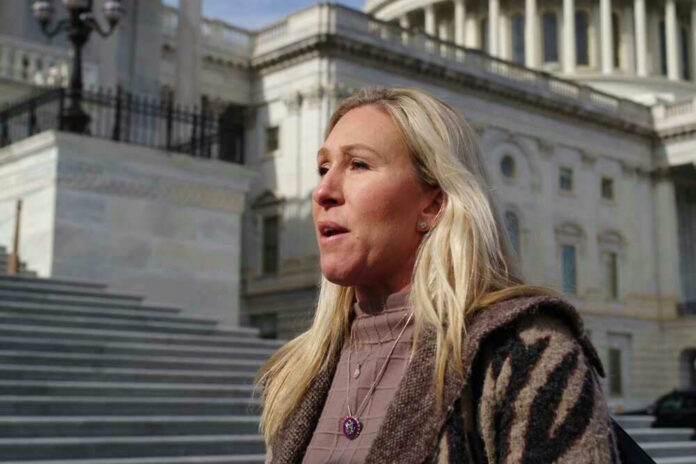
Congress has been left scrambling for answers after Marjorie Taylor Greene rattled the establishment by vowing to gut foreign aid to Israel and other allies from the latest defense spending bill.
At a Glance
- Greene has announced amendments to strip $500 million in aid for Israel, Taiwan, and Jordan from the defense bill.
- She argues U.S. taxpayer money should address crises like border security, drugs, and natural disasters at home.
- Her move exposes deep divisions in the Republican Party and sparks bipartisan backlash in Congress.
- The amendments are unlikely to pass but signal growing skepticism of endless foreign giveaways.
Greene Draws a Line: No More Blank Checks for Foreign Aid
Rep. Marjorie Taylor Greene has had enough of the Capitol’s foreign aid addiction. As Congress debates the 2025 defense appropriations bill, she’s demanding the removal of half a billion dollars earmarked for Israel, matched by cuts for Taiwan and Jordan. Greene’s message is simple: American tax dollars belong to Americans—and if that upsets the D.C. cocktail circuit, so be it.
She’s not shy about calling out the hypocrisy of shelling out billions overseas while American towns are ravaged by fentanyl, mental health crises, and natural disasters that never seem to make it onto the appropriations schedule. The irony here? The same crowd that can’t find a dime to fix a pothole is ready to send another jet full of cash across the ocean.
Greene’s push has lit up social media, with her supporters rallying behind the America First mantra. The Republican Party’s old guard, meanwhile, is scrambling to keep the foreign aid spigot open. The leadership is likely to block her amendments, but not before being forced—for once—to explain why, exactly, Israel needs $3 billion a year from a nation that can’t afford to keep its own border secure or its cities safe.
Washington’s Foreign Aid Obsession Faces a Reckoning
Foreign aid has been a sacred cow in Washington for decades, but Greene is putting it on the chopping block. Her amendments arrive on the heels of Israeli military operations against Iran and renewed fighting in Gaza, both events that have prompted the usual suspects to demand even more support for “our greatest ally.”
Yet Greene points out—rightly, many would argue—that nuclear-armed Israel is perfectly capable of defending itself, especially given its own recent successes. Why, she asks, should Americans foot the bill when their own infrastructure is collapsing and their own families are suffering?
Congressional leaders, both Republican and Democrat, are predictably outraged. Some accuse Greene of undermining U.S. strategic interests, while others paint her as isolationist or simply out of touch.
But for voters tired of endless wars and blank checks to countries that, frankly, don’t always return the favor, her message is resonating. The debate is exposing the cracks in the Republican Party, with the populist base increasingly skeptical of establishment priorities that seem to put everyone except Americans first.
A Growing Chorus Against Endless Foreign Giveaways
Greene’s assault on foreign aid is part of a larger realignment in American politics. Skeptics from both the right and the left are questioning why the world’s wealthiest nation, saddled with historic debt, still acts as a piggy bank for the rest of the globe.
The bipartisan consensus that once shielded foreign aid from scrutiny is eroding. While Greene’s amendments are unlikely to pass—at least this year—they are fueling a debate that’s only growing louder. Her blunt rhetoric and refusal to play by establishment rules are energizing voters who feel betrayed by both parties.
Experts and think tanks are split. Some warn that cutting aid could destabilize key regions or embolden adversaries. Others argue that America’s real strength is at home, and the era of endless interventionism has produced little more than resentment abroad and misery here.
The defense industry, naturally, is concerned about the impact on contracts and jobs tied to foreign military sales. Humanitarian groups warn of the fallout for overseas health and disaster relief. But for many Americans, the question remains: Why are we subsidizing everyone else’s problems while our own go unsolved?