

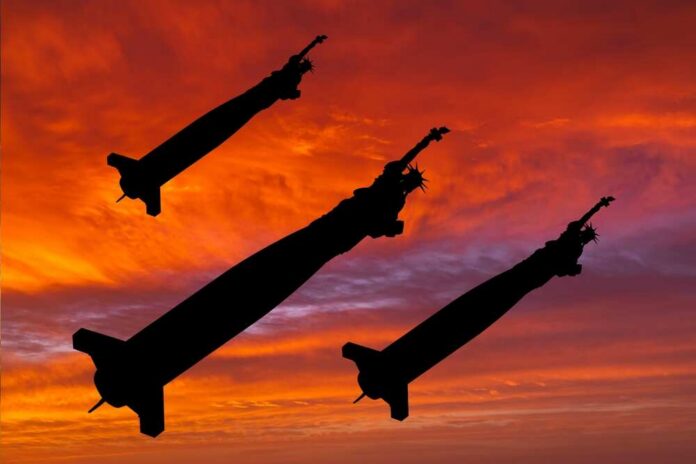
The United States fired so many long-range precision missiles fighting Iran that it now has almost none left to spare for the next fight.
Quick Take
- The U.S. military used at least 45% of its Precision Strike Missiles during the war with Iran, according to a Center for Strategic and International Studies (CSIS) analysis reported by CNN.
- The Army also fired more than 850 Tomahawk cruise missiles, and experts say rebuilding that stock could take two to three years.
- Defense Secretary Pete Hegseth has said replacing the weapons will take “months and years,” depending on the system.
- U.S. officials told CBS News the defense industry cannot build missiles fast enough to keep up with what was used in combat.
What the Pentagon’s Own Numbers Show
Three people familiar with internal Defense Department stockpile reviews told CNN the military burned through nearly half its Precision Strike Missile supply fighting Iran.
Multiple outlets repeated the same 45% figure in the weeks after, showing the estimate held up under scrutiny. Precision Strike Missiles are the Army’s newest long-range weapon, built to hit targets far behind enemy lines with pinpoint accuracy.
U.S. has used 'virtually all' of its long-range precision missiles during Iran war: Reuters https://t.co/Hdd5oEHHXO
— CNBC (@CNBC) August 4, 2026
One Army unit reportedly used up every new Precision Strike Missile it had at the very start of the war, according to Aviation Week reporting. That is not a slow drain over months. That is a unit emptying its shelves almost immediately once the shooting started, a detail that should worry anyone thinking about what happens if a second front opens somewhere else.
Tomahawks and the Years-Long Wait to Rebuild
The Precision Strike Missile was not the only weapon stretched thin. The Army launched more than 850 Tomahawk cruise missiles during the campaign, based on Washington Post reporting cited by Military Times. Experts quoted in that report said restocking Tomahawks to prewar levels would take two to three years, even with factories running at full speed.
CSIS separately found that Precision Strike Missiles and the Joint Air-to-Surface Standoff Missile, another key long-range weapon, would need several months to a year just to get back to where they started.
That gap matters because these are not weapons America can order overnight from a warehouse. They are built one at a time, on production lines that were never designed to replace a war’s worth of missiles in a hurry.
Why Factories Can’t Keep Pace
U.S. officials told CBS News, speaking anonymously, that the defense industrial base simply cannot produce munitions fast enough to replace what the Iran campaign used. That is not a talking point from critics of the Pentagon.
It is officials inside the building admitting the assembly lines have not caught up to the demands of modern combat, a warning that stretches back years before this war even began.
Congress has flagged this exact vulnerability before. A Congressional Research Service report on Army long-range precision fires confirmed the Precision Strike Missile sits at the center of the Army’s future strike plans, not a side project that can be shrugged off. Depleting it during one regional war is a direct hit to the weapon system the Army was counting on for the next decade.
The Readiness Question Nobody Can Fully Answer Yet
Hegseth himself acknowledged the scale of the problem, saying replenishment will take “months and years… depending on the weapon system,” according to CSIS. That is about as close to an official admission as the public has gotten so far. The exact prewar inventory numbers remain classified, so outside analysts are working from estimates and internal sources rather than a published Army ledger.
Still, the pattern across multiple independent reports tells a consistent story. Whether the number is exactly 45% or somewhat higher or lower, America’s stock of the missiles built specifically for long-range precision strikes took a serious hit in a war that lasted weeks, not years.
Rebuilding those stocks will take far longer than it took to use them, and that mismatch is the real story defense planners now have to solve.
For a country that prides itself on military dominance, that math should concern every taxpayer. A strong defense depends on more than brave troops and advanced technology. It depends on factories that can restock the shelves before the next crisis hits, and right now those shelves are looking thin.
Rebuilding this arsenal will likely require sustained investment in production capacity, not just another round of urgent contracts signed after the fact. Lawmakers overseeing defense budgets now face a clear choice: fund the industrial base properly today, or risk having fewer options the next time a president needs to respond fast.
Sources:
youtube.com, en.yenisafak.com, businessinsider.com, cnn.com, congress.gov, americanmind.org