
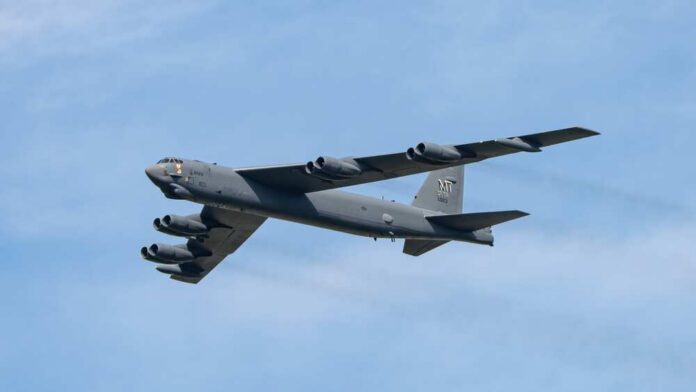
The most advanced bomber on a “routine” test flight fell out of the sky in seconds, and the people in charge still say they do not know why.
Story Snapshot
- Eight people died when a B-52 bomber crashed seconds after takeoff from Edwards Air Force Base.
- The Air Force calls it an accident under investigation and has released no cause.
- The flight was a radar test mission with a mixed crew of military, civilians, and Boeing staff.
- The crash was so violent that officials declared it “unsurvivable” after watching the footage.
A brutal crash with almost no time to react
The B-52 Stratofortress lifted off from Edwards Air Force Base in the California desert a little after 11:20 a.m., then never climbed to safety. Witness footage and base statements point to a short, doomed flight that ended on or near the airfield with a huge fire and thick black smoke.
Officials on scene saw enough in that early footage to say the impact was “unsurvivable” and that there was “really nothing” left of the aircraft.[1]
Eight people were on board. All are dead or presumed dead.[1] The Air Force describes them as “eight great Americans” and confirms the group included uniformed service members, government civilians, and contractors.[1][2]
Boeing later admitted that two of its own employees died in the crash, which means this was not just a military event; it was also a corporate loss and a test mission with shared responsibility on board.[1]
A “routine” test mission that was anything but routine
Base leaders stress that this was a “routine test mission” supporting a Radar Modernization Program on the aging bomber.[1][2] On paper, that makes sense: Edwards is the place where the United States pushes aircraft to their limits.
But calling it “routine” can hide the truth that test work often runs closer to the edge than normal flights. A B-52 carrying test gear, extra people, and experimental systems is not the same as a bomber droning home from a training run.
UPDATE: 8 crew members killed in B-52 crash at Edwards Air Force Base in California pic.twitter.com/xgOdSwA70n
— BNO News (@BNONews) June 15, 2026
Edwards officials say the aircraft crashed “shortly after takeoff” and that the cause remains unknown. That timing matters. Many serious crashes happen on approach or in combat.
Losing a massive bomber right after liftoff suggests either a sudden mechanical failure, a severe loss of control, or a critical error during a high-workload phase. Yet in public, commanders have stuck to one line: the crash is under investigation, and there are “no indications” yet about the cause.[1]
What we know, what we do not, and why that gap matters
So far, the record is clear on a few hard facts. The bomber departed on a radar test flight, crashed within minutes, and burned so badly that recovery teams found very little intact.[1] Emergency crews rushed in, closed the airfield, and then reopened base access once the fire was under control.[2]
Investigators now face the slow, grim work: securing wreckage, pulling flight data, reading maintenance logs, and mapping every second between brake release and impact.
The record is also clear on what we do not know. No one has produced cockpit recordings, radar tracks, or tower audio in public. There is no official word of a bird strike, engine failure, control problem, or crew mistake.
Online forums and social media chatter mention possible engine losses and flocks of migratory birds, but those are rumors, not evidence. In plain terms, the Air Force controls the black boxes and the twisted metal, and it will decide when and how the story comes out.
History says early answers are slow and rarely simple
This is the deadliest B-52 crash since 1982, when nine crew members died during a training event at Mather Air Force Base near Sacramento.
The long accident history of the B-52 shows many causes: wrong trim settings, over-stressed wings, maintenance issues, and sometimes errors made in a few rushed seconds.[2] These reports almost always arrive months later, after boards sift through data and argue over every broken bolt and burned wire.
8 people died in B-52 bomber crash at US Air Force base in Southern California, officials say. https://t.co/T9N1U7dGoA
— ELLIOT IN THE MORNING (@EITMonline) June 16, 2026
Right now, the Edwards case sits in that gray zone between tragedy and accountability. On one side, base leaders focus on grief and uncertainty, and that is proper for the first days after eight deaths.[1]
On the other, this was a United States bomber, loaded with test gear and mixed with corporate staff, crashing on American soil in clear conditions. Common sense says the public deserves clear, evidence-based answers about what failed, who signed off, and how it will be fixed.
Sources:
[1] Web – 8 people died in B-52 bomber crash at US Air Force base in Southern …
[2] Web – 8 people killed in B-52 bomber crash during ‘routine test mission …