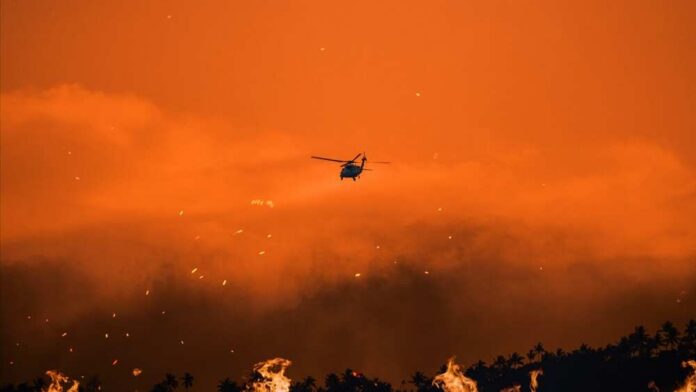
Three wildland firefighters died on June 27, 2026, trapped by a fast-moving fire on the Colorado-Utah border — and the full story of how it happened may take months to surface.
Story Snapshot
- Three firefighters were killed and two others injured in a burnover on the Snyder Fire near the Colorado-Utah border on June 27, 2026.
- The fire burned roughly 28,000 acres with zero percent containment at the time of the deaths.
- Colorado Governor Jared Polis declared a disaster emergency and called in the Colorado National Guard.
- The victims have not yet been publicly identified, and no detailed safety findings have been released.
What Happened on the Utah-Colorado Border
The fire that killed three firefighters started as the Snyder Mesa Fire in Grand County, eastern Utah. It spread east into Colorado, merged with the Knowles and Gore fires, and became known as the Snyder Fire.
By the time the fatalities occurred on Saturday, June 27, the fire had consumed an estimated 28,000 acres and was zero percent contained. Two other crew members survived but are being treated for serious burn injuries.[1]
The U.S. Wildland Fire Service confirmed the deaths overnight Saturday and called it a burnover — the term used when fire overtakes a crew, cutting off their escape. The agency praised the firefighters’ “bravery, dedication, and sacrifice” in a public statement.[2]
Colorado Governor Polis quickly declared a disaster emergency, authorizing the Colorado National Guard to support the response. Evacuation warnings went out to several smaller communities in Mesa County, Colorado.[1]
What a Burnover Actually Means for a Crew
A burnover happens when fire behavior changes faster than a crew can react. Escape routes disappear. Safety zones get cut off. Firefighters are trained to deploy fire shelters as a last resort, but in extreme conditions, even those can fail.
Winds of 50 to 60 miles per hour were reported across the broader region that day, which can turn a manageable fire line into a wall of flame in minutes.[3] That kind of rapid change leaves almost no margin for error.
This is not a new problem. The 1994 South Canyon Fire in Colorado killed 14 firefighters in a nearly identical scenario — a fast wind shift, compromised escape routes, and a crew caught in the open.[6] That disaster led to major safety reforms.
Yet burnovers have continued to occur across the western United States in the decades since, a fact that raises hard questions about whether the lessons from past tragedies are being fully applied on the fire line today.
A procession on Sunday honored the three firefighters who lost their lives while battling the Snyder Fire, a wildfire burning along the Utah-Colorado border. Officials said two other firefighters remained hospitalized with burn injuries. pic.twitter.com/Bc1sAbrUwE
— Breaking911 (@Breaking911) June 29, 2026
The Questions That Come After the Grief
Right now, the public knows very little beyond the basic facts. The victims have not been named. The two injured firefighters’ conditions have not been detailed beyond “being treated for burn injuries.”[2] No meteorological logs, no crew testimony, and no tactical review have been made public.
That is normal in the first 48 hours — investigators need time to secure the scene and interview survivors. Federal entrapment protocols require witness statements to wait 24 to 72 hours after the incident while crew members receive critical-incident stress support.[14]
🚨 BREAKING: Three firefighters are dead after battling a wildfire along the Utah-Colorado border.
Officials say three wildland firefighters were killed while fighting the rapidly growing #SnyderFire. Two other firefighters were seriously injured and transported to the hospital… pic.twitter.com/Sdz47r50Lg
— Chase Thomason (@ChaseThomason) June 28, 2026
What matters is what comes next. A full investigation team — including fire behavior analysts, weather specialists, and safety officers — will examine exactly what happened.[16] The findings should be made public in full. The families of these three firefighters deserve that.
So does every wildland firefighter who will be sent into a fire line next season. Honoring bravery is right and proper, but honoring bravery without asking hard operational questions is how the same tragedy keeps repeating itself.
A Broader Fire Season Already Under Pressure
The Snyder Fire did not burn in isolation. The region was already dealing with a separate Cottonwood Fire burning more than 92,000 acres, drought conditions across the Southwest, and fireworks restrictions across much of Utah ahead of the Fourth of July.[3]
The scale of the fire season stretching resources thin is exactly the kind of environment where crews get pushed into higher-risk positions. That context does not explain what happened on June 27, but it is part of the picture investigators will need to examine honestly.
Sources:
[1] Web – 3 firefighters killed, 2 injured while tackling wildfires on the …
[2] Web – Three Firefighters Killed, 2 Injured in Snyder Wildfire on Utah …
[3] Web – 3 firefighters killed responding to Snyder wildfire on Utah-Colorado …
[6] Web – Three firefighters killed, 2 injured in Snyder wildfire on Utah …
[14] Web – Three firefighters killed while tackling major wildfires along …
[16] Web – [PDF] Wildland firefighter entrapment avoidance: modelling evacuation …