
A single judge just let President Donald Trump push ahead with a federal voter list and tighter mail-ballot rules—and the real fight has barely started.
Story Snapshot
- A Trump-appointed judge refused, for now, to block the executive order on mail voting and a national voter list
- The order expands federal power over elections, directing national voter-eligibility data and limits on mail ballot delivery
- The ruling hinges on timing and “speculative” harm, not a final verdict on constitutionality
- The midterm elections remain largely untouched—for now—but the groundwork for a much bigger clash is clear
A federal judge hands Trump an early but limited win
Federal Judge Carl Nichols in Washington, D.C., appointed by President Donald Trump, declined to block Trump’s executive order on mail voting at this early stage, leaving the administration free to keep implementing it for now.[1][4]
The challengers—Democrats and voting-rights groups—argued the order is unconstitutional because Congress, not the president, sets federal election rules.[4] Nichols said their alleged harms were “too speculative” at this point, which is judge-speak for “come back when something concrete happens.”[1][4]
The judge’s decision does not bless the order as lawful, but it does change the battlefield. Election-law fights often begin with emergency requests to stop new rules before they bite.[4]
When a judge refuses that request, activists lose leverage, states face pressure to comply, and voters start to assume the new regime is “the way it is.” That psychological shift matters, especially for older voters who already suspect the system favors chaos.[3]
What Trump’s executive order actually does
Trump’s March order directs federal agencies, including the Department of Homeland Security and the United States Postal Service, to help compile data used to check state voter rolls for noncitizens and ineligible voters.[1]
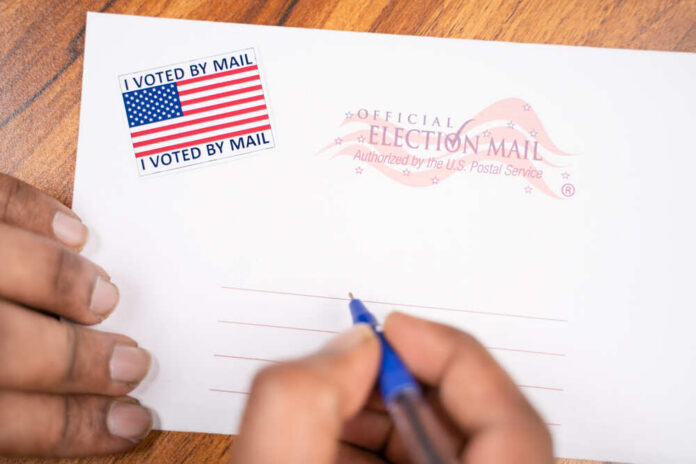
It requires the administration to draw up lists of eligible voters in each state and provide the Postal Service with a list of people authorized to receive mail ballots.[1][2] The Postal Service must then deliver ballots only to those listed, effectively tying mail voting to a new federal eligibility filter.[2]
A US judge declined to block President Trump's executive order tightening rules on mail-in voting, but left the door open for the Democratic Party to challenge it again after the administration takes further steps to implement the measure https://t.co/VDZv3TJZdI pic.twitter.com/cGujpkjY4o
— Reuters (@Reuters) May 28, 2026
Supporters frame this as a straightforward election-integrity upgrade: clean lists, eligible voters only, and fewer loose ballots sloshing around in the mail.[1][3] That argument resonates with many who watched 2020’s rushed mail-voting expansions and concluded that tighter controls are needed.
Critics respond that the president is inserting federal agencies into what the Constitution and longstanding practice leave to the states and Congress, shifting power over who gets a ballot to Washington.[3][4]
Why the judge said “too soon” instead of “no way”
Nichols focused on timing, not philosophy. He ruled that because the order is still being implemented, the plaintiffs had not yet shown concrete, imminent harm sufficient to justify an emergency block.[4]
In plain English: until there is clear proof that specific voters will be denied ballots or states will be forced into illegal steps, the court will wait. Plaintiffs can renew their challenge later, after they show how the order is actually used in practice.[4]
That distinction matters more than headlines suggest. The ruling does not decide whether Trump’s order is constitutional or whether it properly respects state control over elections.[4]
It simply leaves the status quo as “Trump’s order moves forward, legal fight continues.” For anyone who thinks courts should avoid micromanaging elections unless absolutely necessary, this tracks with conservative instincts: require real evidence of harm before a judge overrides elected officials.[4]
No immediate midterm shock, but the stakes are obvious
Coverage of the case stresses that there is no immediate effect on the coming midterm elections because the federal eligibility lists are not yet fully built or integrated into state systems.[3]
States still control how they run their elections, and many already have their own criteria for who can vote by mail. The executive order adds new federal infrastructure and pressure, but it does not overnight erase state statutes or local election procedures.[4]
Judge refuses to block Trump order to limit mail voting. There's no immediate effect on the midterms https://t.co/LFycFLT0bX pic.twitter.com/GuxvxEtPp0
— WHIO Radio (@WHIORadio) May 31, 2026
The real stakes lie in what this order normalizes. If the federal government successfully builds a national voter-eligibility backbone and ties mail-ballot delivery to that system, the next administration—Republican or Democrat—will inherit a powerful lever over access to the ballot.
From a limited-government perspective, that is a double-edged sword: stronger tools to stop fraud, but also a tempting mechanism for future Washington overreach.[3][4]
Sources:
[1] Web – Judge refuses to block Trump order to limit mail voting. There’s no …
[2] YouTube – Judge refuses to block President Trump’s executive order …
[3] YouTube – Federal judge declines to block Trump mail-in voting executive order
[4] Web – Federal judge declines to stop Trump order to limit mail voting