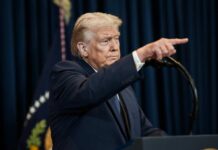

The Supreme Court cleared the way for President Trump’s mail-voting order to move forward before the midterms, and that changes the battlefield right now.
At a Glance
- The Supreme Court lifted an injunction and said the suing states lacked standing.
- The executive order directs federal agencies and the Postal Service to set mail-ballot standards.
- Lower courts earlier blocked core parts and said Trump exceeded his authority.
- The Supreme Court did not rule on the order’s final legality.
What The Supreme Court Actually Did
The Supreme Court issued an unsigned order on August 24 that stayed a lower-court block covering 23 states and Washington, D.C. The Court said the states lacked standing to challenge a key section because it did not regulate them directly.
That ruling reopened the path for the administration to act before ballots go out. The order did not decide who wins at the end. It set the practical rules for the next few weeks.
The Supreme Court handed President Trump a victory, allowing his administration to enforce his "election integrity" executive order restricting mail-in voting ahead of the November midterms.
The ruling clears the way for the Trump administration to move forward with restrictions… pic.twitter.com/7dKrOV28i5
— Fox News (@FoxNews) August 24, 2026
Americans should read this as a win for separation of powers and for common-sense timing. Courts often decide election fights by who gets an early injunction.
Removing a broad, pre-election block puts policy back in the hands of elected officials, unless someone with a proper legal claim steps up. That aligns with the idea that courts should avoid running elections from the bench while votes are near.
What The Executive Order Tries To Do
The March directive tells the Department of Homeland Security and the Social Security Administration to build a list of adult citizens from federal databases. It asks states to reconcile that list with their rolls.
It directs the United States Postal Service to set uniform handling rules and to limit ballot processing to voters who appear on the verified lists. The White House argues this protects the mail and secures ballots in a uniform way across the country.
That federal-led structure aims to fix two weak links. First, states maintain very different voter lists, and those lists often lag behind deaths and moves. Second, mail ballots pass through a federal carrier that must handle high volumes at speed.
A single national standard promises faster sorting, clearer tracking, and fewer loose ends. Supporters see it as guardrails, not a federal takeover, because states still design ballots and count votes.
Why Lower Courts Pushed Back
A federal district judge in Boston ruled in June that the president likely overstepped. The judge said election rules come from state legislatures and Congress, not the Oval Office.
The court also said the United States Postal Service lacks authority to issue binding mail-voting regulations. An appeals court left parts of those blocks in place in July. Those rulings froze much of the order through most of the summer.
That creates a classic pre-election standoff. The administration argues it is managing federal property and data to protect election mail. The states and voting groups argue the order crosses the line into setting voter eligibility and ballot rules.
The Supreme Court’s stay does not erase those arguments. It only says the states who sued did not show the kind of direct legal injury needed to stop Section 2(b) now.
What Matters Before Ballots Drop
Time pressure is the real power here. Election calendars are tight, mail volumes will spike soon, and agencies must know what rules they can apply.
With the stay in place, the Postal Service and agencies can prepare under the order unless another plaintiff with standing lands a new injunction. If that does not happen fast, new standards may shape how ballots move even if courts later trim them back.
The Supreme Court gave a win for President Trump on the implementation of his executive order restricting mail-in voting, ruling that states who sued did not have the legal right to challenge it.https://t.co/hqt4lhUn0j
— The Rule 5 Texan (@Rule5Tweets) August 25, 2026
Here is the practical test for common sense. Uniform handling rules for the mail are squarely federal. Securing federal systems and data is a core executive job. But drawing a hard federal line on who may receive a ballot is trickier.
That feels closer to setting election policy. The cleaner path is narrow and targeted: tighten chain-of-custody in the mail, improve tracking, harden identity checks where federal law already speaks, and leave voter eligibility rules to states and Congress.
Sources:
apnews.com, supremecourt.gov, axios.com, cnn.com, theguardian.com, reuters.com